Woman Smiling

Oct 10, 2025

How Hopfias Agentic AI Rewrites the Due Diligence Workflow

Chris CH Moon

Private-market due diligence suffers from a structural weakness: massive volumes of non-public information must be analyzed with consistency, precision, and trust—yet traditional frameworks depend on fragmented human review. Below is the same content reorganized into a clear, structured format, aligned with a practical, checklist-style narrative.
The Core Challenge in Private-Market Due Diligence

Private-market diligence environments are defined by:

  • Vast quantities of confidential, heterogeneous documents

  • High dependency on parallel human review

  • Increasing risk of inconsistency as document volume scales

From investment memos and contracts to financial statements, operational reports, and legal filings, the burden of maintaining analytical coherence grows exponentially. The challenge is not simply reading documents—it is ensuring that all extracted insights remain logically consistent across sources.

Why Traditional Approaches Break Down

Human diligence teams typically work in parallel:

  • Reviewing documents independently

  • Extracting key terms and figures

  • Reconciling discrepancies manually

  • Escalating clarifying questions late in the process

As scale increases, so do blind spots. Critical interdependencies between documents are easily missed, and maintaining a single, coherent analytical narrative becomes increasingly difficult.

Why a Single LLM Is Not Enough

A standalone LLM assistant can summarize or answer isolated questions, but it cannot:

  • Track contextual boundaries across documents

  • Determine when specific figures or clauses apply

  • Resolve semantic dependencies between contracts and financials

  • Identify cross-document contradictions or missing information

True diligence requires structured reasoning across documents—not isolated pattern recognition.

How Hopfia Intervenes at the Bottlenecks

Hopfia is engineered specifically for the points where diligence friction is most severe.

Knowledge Unit Decomposition

Instead of summarizing documents, Hopfia’s Indepth engine:

  • Breaks materials into structured “knowledge units”

  • Interprets each unit in its proper context

  • Maps semantic and logical connections across documents

This allows the system to automatically detect:

  • Inconsistencies

  • Contradictions

  • Missing or incomplete information

Analysts no longer spend time on line-by-line cross-checking—they begin directly where judgment matters most.

Automated Cross-Document Interpretation

One of the most time-intensive diligence tasks is synthesis—connecting insights across legal, financial, and operational domains.

Hopfia’s agentic approach:

  • Traces relationships between documents autonomously

  • Flags logical gaps where information should exist but does not

  • Interprets implications, not just matches keywords

Example:
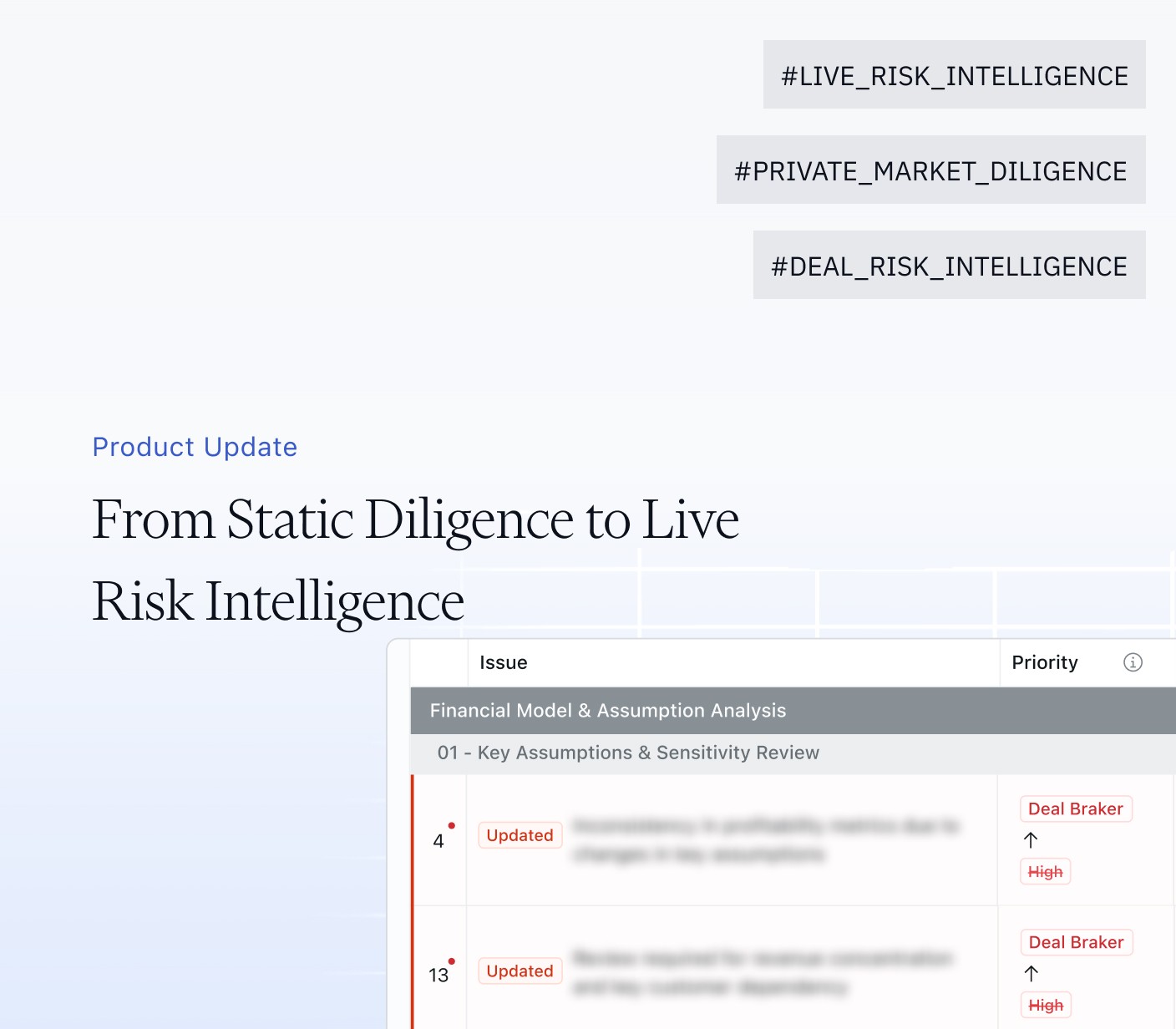
If a contract specifies a financial threshold, Hopfia automatically retrieves the relevant financial data, compares the figures, and highlights the resulting risk or implication. This is not Q&A automation—it is full logical framework interpretation.

Value Even Before Formal Due Diligence Begins

Effective diligence starts with asking the right questions—and these vary by:

  • Deal structure

  • Investment strategy

  • Data room composition

Hopfia supports this interpretative process by:

  • Integrating legal, financial, and commercial perspectives

  • Prioritizing focus areas dynamically

  • Executing workflows that mirror the reasoning of an experienced diligence team

The result is not a static checklist, but a living analytical framework.

Why Accuracy Matters More Than Speed

Hopfia’s primary value is accuracy, not velocity.

Due diligence is fundamentally a risk-management discipline. Faster workflows alone do not reduce uncertainty. What matters is:

  • Minimizing blind spots

  • Detecting inconsistencies early

  • Preserving the integrity of the analytical structure

Hopfia is built around these principles, allowing investors to focus on higher-order judgment rather than mechanical document tracing.

Preparing for the Future of Diligence

Diligence complexity will only increase:

  • Document volumes will continue to grow

  • Data formats will become more diverse

  • Investors will demand deeper transparency and stronger explanations

Hopfia’s agentic framework is a practical response to this reality. By producing high-fidelity, structured outputs, it enables analysts to spend their time where it truly matters—making strategic decisions grounded in complete, coherent, and defensible analysis.

AI Due Diligence Insights

AI Due Diligence Insights

Private-market due diligence suffers from a structural weakness: massive volumes of non-public information must be analyzed with consistency, precision, and trust—yet traditional frameworks depend on fragmented human review. Below is the same content reorganized into a clear, structured format, aligned with a practical, checklist-style narrative.
The Core Challenge in Private-Market Due Diligence

Private-market diligence environments are defined by:

  • Vast quantities of confidential, heterogeneous documents

  • High dependency on parallel human review

  • Increasing risk of inconsistency as document volume scales

From investment memos and contracts to financial statements, operational reports, and legal filings, the burden of maintaining analytical coherence grows exponentially. The challenge is not simply reading documents—it is ensuring that all extracted insights remain logically consistent across sources.

Why Traditional Approaches Break Down

Human diligence teams typically work in parallel:

  • Reviewing documents independently

  • Extracting key terms and figures

  • Reconciling discrepancies manually

  • Escalating clarifying questions late in the process

As scale increases, so do blind spots. Critical interdependencies between documents are easily missed, and maintaining a single, coherent analytical narrative becomes increasingly difficult.

Why a Single LLM Is Not Enough

A standalone LLM assistant can summarize or answer isolated questions, but it cannot:

  • Track contextual boundaries across documents

  • Determine when specific figures or clauses apply

  • Resolve semantic dependencies between contracts and financials

  • Identify cross-document contradictions or missing information

True diligence requires structured reasoning across documents—not isolated pattern recognition.

How Hopfia Intervenes at the Bottlenecks

Hopfia is engineered specifically for the points where diligence friction is most severe.

Knowledge Unit Decomposition

Instead of summarizing documents, Hopfia’s Indepth engine:

  • Breaks materials into structured “knowledge units”

  • Interprets each unit in its proper context

  • Maps semantic and logical connections across documents

This allows the system to automatically detect:

  • Inconsistencies

  • Contradictions

  • Missing or incomplete information

Analysts no longer spend time on line-by-line cross-checking—they begin directly where judgment matters most.

Automated Cross-Document Interpretation

One of the most time-intensive diligence tasks is synthesis—connecting insights across legal, financial, and operational domains.

Hopfia’s agentic approach:

  • Traces relationships between documents autonomously

  • Flags logical gaps where information should exist but does not

  • Interprets implications, not just matches keywords

Example:
If a contract specifies a financial threshold, Hopfia automatically retrieves the relevant financial data, compares the figures, and highlights the resulting risk or implication. This is not Q&A automation—it is full logical framework interpretation.

Value Even Before Formal Due Diligence Begins

Effective diligence starts with asking the right questions—and these vary by:

  • Deal structure

  • Investment strategy

  • Data room composition

Hopfia supports this interpretative process by:

  • Integrating legal, financial, and commercial perspectives

  • Prioritizing focus areas dynamically

  • Executing workflows that mirror the reasoning of an experienced diligence team

The result is not a static checklist, but a living analytical framework.

Why Accuracy Matters More Than Speed

Hopfia’s primary value is accuracy, not velocity.

Due diligence is fundamentally a risk-management discipline. Faster workflows alone do not reduce uncertainty. What matters is:

  • Minimizing blind spots

  • Detecting inconsistencies early

  • Preserving the integrity of the analytical structure

Hopfia is built around these principles, allowing investors to focus on higher-order judgment rather than mechanical document tracing.

Preparing for the Future of Diligence

Diligence complexity will only increase:

  • Document volumes will continue to grow

  • Data formats will become more diverse

  • Investors will demand deeper transparency and stronger explanations

Hopfia’s agentic framework is a practical response to this reality. By producing high-fidelity, structured outputs, it enables analysts to spend their time where it truly matters—making strategic decisions grounded in complete, coherent, and defensible analysis.

AI Due Diligence Insights

AI Due Diligence Insights

Cut Your DD Time by 90%Leave No Stone Unturned

Get Your Due Diligence Issue Lists in Under 60 Minutes.

Copyright © 2026 Hopfia AI Corporation. All rights reserved.

Cut Your DD Time by 90%Leave No Stone Unturned

Get Your Due Diligence Issue Lists in Under 60 Minutes.

© 2026 Hopfia. All rights reserved.

Cut Your DD Time by 90%Leave No Stone Unturned

Get Your Due Diligence Issue Lists in Under 60 Minutes.

Copyright © 2026 Hopfia AI Corporation. All rights reserved.