Oct 10, 2025

What is AI Due Diligence? Navigating the Market Confusion

Hopfia Team

Definition of AI Due Diligence

In the modern investment landscape, Artificial Intelligence is essential in two distinct ways. First, it serves as a primary driver of value creation and a critical component of performance. Second, it is a transformative force when integrated as autonomous agents into the investment process and its core activities.

In a broader sense, AI Due Diligence involves deploying AI to re-engineer the due diligence process, effectively streamlining the most resource-heavy and time-critical stage of the investment lifecycle. We have moved beyond manual review and basic 'assistant' tools that merely extract or summarize data. We are now entering the era of Value Chain Re-engineering, where AI transcends its role as a passive tool to become an active execution agent.

Beyond Marketing Jargon: The Reality of AI in Due Diligence

The current market is flooded with speculative concepts of “AI Due Diligence,” where marketing buzzwords often outpace actual technological capability. Rather than delivering functional automation, many players are simply populating the space with visionary rhetoric. A closer look reveals that most existing platforms remain confined to secondary assistance features: bulk extracting “key terms,” generating basic document summaries, scoring, or offering simple Q&A chatbot interfaces.

While these features are branded as revolutionary, they are often the result of basic parallel processing— executing LLM queries across disparate files. Consequently, the utility of such tools remains purely administrative; they function as glorified search and extraction utilities rather than the sophisticated analytical partners required for complex deal-making.

They often produce 'plausible-sounding' responses that, upon professional scrutiny, prove to be generic or superficial. An experienced expert can discern within seconds whether a summary is merely stating the obvious without grasping the underlying strategic implications.

The limitation of these tools becomes even more apparent when we look at the core definition of due diligence. By its nature:

“Due diligence is a structured, multi-disciplinary review of a target company’s business, financials, legal, and regulatory position, tax, operations, management, and technology. Its objective is to validate the investment thesis, identify risks and opportunities, and inform valuation, deal structure, and contractual protections.”

When measured against this institutional standard, the utility of a such search and extraction engine is fundamentally restricted.

True due diligence execution begins with discovery, not just analysis. Before one can assess a risk, it must first be identified. Traditional LLM tools are fundamentally reactive; they remain dormant until a human reviewer prompts them to find a specific term or summarizes a known document.

To bridge this gap, it must possess the proactive intelligence to scan the entire data landscape and identify the risks itself. This is the critical leap: transitioning from a tool that answers questions to an agent that finds the questions that need to be asked. Only after this autonomous discovery can the agent perform the analytical depth required to assess how a specific risk impacts valuation or alters contractual protections.

1. AI Assistant Tools: Digitizing Manual Labor

The first wave of AI adoption in due diligence focused on augmenting specific, isolated tasks. These AI Assistant Tools are designed primarily to alleviate the administrative burden of manual queries and basic information retrieval. Their core capabilities typically include:

  • Data Extraction: Mechanically pulling specific figures or line items from financial statements or other contract documents.

  • Keyword Identification: Locating predefined “key terms” or standard boilerplate clauses within a contract set.

  • Document Q&A: Functioning as a reactive chatbot to provide answers based on the immediate context of a provided text.

While these tools are valuable for reducing mechanical work, they possess a fundamental limitation: they remain entirely dependent on a human expert to lead the discovery and connect the dots. They can only provide disparate pieces of the puzzle based on specific human inputs; they lack the cognitive architecture to autonomously see the whole picture or identify the strategic risks buried within the complexity.

2. AI Due Diligence Agents: Re-engineering Professional Logic

This is where the paradigm shifts. Rather than merely assisting with isolated fragments of the process, a true AI Due Diligence Agent executes the complex reasoning required for a deep-dive audit. Instead of simply locating a clause, the agent autonomously evaluates the risk it poses, scores its severity based on specific deal context, and generates a structured, institutional-grade report.

To replicate the workflow of professional investors, an AI Due Diligence Agent is built upon an advanced and complex technical architecture, featuring:

  • Ontology & Knowledge Base: To comprehend the sophisticated and interconnected relationships across diverse domains, including but not limited to legal, financial, commercial, and technical frameworks.

  • Multi-hop Reasoning: The capacity to link disparate information across tens of thousands of pages to identify hidden discrepancies or compounding risks.

  • Explainable AI (XAI): Providing rigorous traceability, ensuring that every conclusion can be mapped back to the source data for immediate human verification.

Because this methodology emulates the intricate reasoning of the human brain, it naturally involves a high volume of computational steps and token consumption. Unlike a simple chatbot that provides superficial answers, an execution agent performs a thorough, multi-layered analysis to ensure the final deliverable meets the rigorous standards of a high-stakes transaction.

3. The Reality of M&A Complexity: Why Conventional Tools Fail

At first glance, contract review or clause extraction might seem like a solved problem for modern LLMs. However, there is a fundamental gap between reviewing a typical commercial contract and executing a professional M&A audit.

A typical commercial agreement usually spans a few dozen pages. In contrast, complex acquisition agreements consist of hundreds of pages in the main contract alone. When ancillary agreements, disclosure schedules, and previously executed related contracts are factored in, the volume increases exponentially.

The true challenge lies in identifying inconsistencies, hidden risks, and material issues across this massive, interconnected document set—autonomously, without relying on specific human prompts. This is where most systems fail.

They lack the cognitive depth to cross-reference disparate clauses and recognize when a provision in an ancillary document contradicts a warranty in the main agreement. Even in what is considered a small portion of the due diligence process, the inability to reason across complexity renders most tools inadequate for institutional-grade scrutiny.

The Shift in the Value Chain: Proactive Intelligence

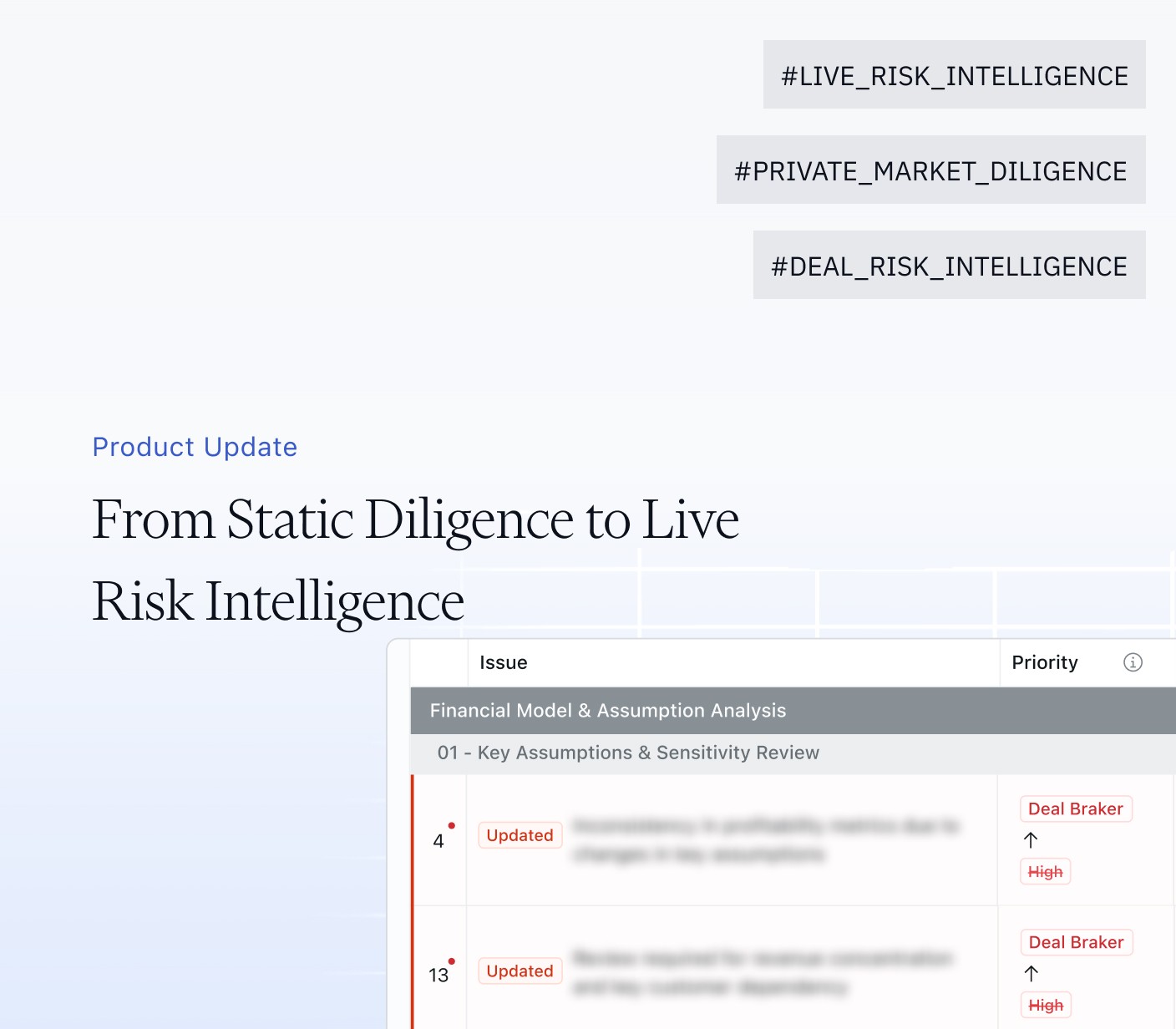
The emergence of AI agents capable of autonomous execution is fundamentally re-engineering the due diligence value chain. This shift represents a move from Reactive Assistance to Proactive Intelligence, fundamentally altering the traditional order of operations in a deal.

From Human-Led Inquiry to Agent-Led Discovery

In the traditional workflow, human associates must first manually scan documents, identify potential red flags, and then ask questions to dig deeper. This process is inherently limited by human bandwidth and the “needle-in-a-haystack” nature of massive VDRs.

With AI Due Diligence Agents, this sequence is inverted. The agent proactively identifies risks, maps out anomalies, and presents structured findings before the human reviewer even begins their assessment. The workflow shifts from “Human finds, AI assists” to “Agent discovers, Human decides.”

Simultaneous Optimization: Accuracy, Time, and Resources

This paradigm shift delivers a triple-win for investment firms:

  • Enhanced Accuracy: By scanning 100% of the data without fatigue, agents eliminate the oversight risks inherent in manual sampling.

  • Drastic Time Reduction: What used to take weeks of manual review is compressed into hours of high-level validation.

  • Resource Efficiency: High-cost professional talent is no longer bogged down by repetitive data retrieval and initial screening.

Focusing on High-Value Strategic Decision-Making

As with every major technological advancement, the automation of the “execution” layer does not replace the human expert. Instead, it elevates their role. By delegating the exhaustive labor of risk identification to an agent, senior deal-makers can focus their cognitive resources on complex, high-stakes strategic decisions that require nuanced judgment, negotiation, and long-term vision.

In the future of deal-making, the competitive edge will not belong to those who work the hardest at manual review, but to those who leverage the most advanced agents to gain the clearest view of the risk landscape.

The New Standard of Institutional-Grade Due Diligence

The transition from AI as a assistant to AI as an autonomous execution agent marks a pivotal moment in the evolution of the investment industry. As we have explored, the true power of AI Due Diligence lies not just in expanding the scope of what we audit, but in fundamentally re-engineering the methodology of how those audits are performed.

By inverting the traditional workflow—moving from human-led inquiry to agent-led discovery—investment firms can finally overcome the physical limitations of manual VDR review. This shift does more than just save time; it establishes a new benchmark for accuracy and comprehensive risk management. When an agent proactively identifies hundreds of risks and anomalies, it empowers senior deal-makers to transcend the tedious labor of data verification.

Ultimately, the goal of this advancement is to return the focus of professional investors to their highest-value activity: Strategic Decision-Making.

The future of deal-making is no longer about who can process the most documents, but who can most effectively verify the intelligence behind the data.

AI Due Diligence Insights

AI Due Diligence Insights

Definition of AI Due Diligence

In the modern investment landscape, Artificial Intelligence is essential in two distinct ways. First, it serves as a primary driver of value creation and a critical component of performance. Second, it is a transformative force when integrated as autonomous agents into the investment process and its core activities.

In a broader sense, AI Due Diligence involves deploying AI to re-engineer the due diligence process, effectively streamlining the most resource-heavy and time-critical stage of the investment lifecycle. We have moved beyond manual review and basic 'assistant' tools that merely extract or summarize data. We are now entering the era of Value Chain Re-engineering, where AI transcends its role as a passive tool to become an active execution agent.

Beyond Marketing Jargon: The Reality of AI in Due Diligence

The current market is flooded with speculative concepts of “AI Due Diligence,” where marketing buzzwords often outpace actual technological capability. Rather than delivering functional automation, many players are simply populating the space with visionary rhetoric. A closer look reveals that most existing platforms remain confined to secondary assistance features: bulk extracting “key terms,” generating basic document summaries, scoring, or offering simple Q&A chatbot interfaces.

While these features are branded as revolutionary, they are often the result of basic parallel processing— executing LLM queries across disparate files. Consequently, the utility of such tools remains purely administrative; they function as glorified search and extraction utilities rather than the sophisticated analytical partners required for complex deal-making.

They often produce 'plausible-sounding' responses that, upon professional scrutiny, prove to be generic or superficial. An experienced expert can discern within seconds whether a summary is merely stating the obvious without grasping the underlying strategic implications.

The limitation of these tools becomes even more apparent when we look at the core definition of due diligence. By its nature:

“Due diligence is a structured, multi-disciplinary review of a target company’s business, financials, legal, and regulatory position, tax, operations, management, and technology. Its objective is to validate the investment thesis, identify risks and opportunities, and inform valuation, deal structure, and contractual protections.”

When measured against this institutional standard, the utility of a such search and extraction engine is fundamentally restricted.

True due diligence execution begins with discovery, not just analysis. Before one can assess a risk, it must first be identified. Traditional LLM tools are fundamentally reactive; they remain dormant until a human reviewer prompts them to find a specific term or summarizes a known document.

To bridge this gap, it must possess the proactive intelligence to scan the entire data landscape and identify the risks itself. This is the critical leap: transitioning from a tool that answers questions to an agent that finds the questions that need to be asked. Only after this autonomous discovery can the agent perform the analytical depth required to assess how a specific risk impacts valuation or alters contractual protections.

1. AI Assistant Tools: Digitizing Manual Labor

The first wave of AI adoption in due diligence focused on augmenting specific, isolated tasks. These AI Assistant Tools are designed primarily to alleviate the administrative burden of manual queries and basic information retrieval. Their core capabilities typically include:

  • Data Extraction: Mechanically pulling specific figures or line items from financial statements or other contract documents.

  • Keyword Identification: Locating predefined “key terms” or standard boilerplate clauses within a contract set.

  • Document Q&A: Functioning as a reactive chatbot to provide answers based on the immediate context of a provided text.

While these tools are valuable for reducing mechanical work, they possess a fundamental limitation: they remain entirely dependent on a human expert to lead the discovery and connect the dots. They can only provide disparate pieces of the puzzle based on specific human inputs; they lack the cognitive architecture to autonomously see the whole picture or identify the strategic risks buried within the complexity.

2. AI Due Diligence Agents: Re-engineering Professional Logic

This is where the paradigm shifts. Rather than merely assisting with isolated fragments of the process, a true AI Due Diligence Agent executes the complex reasoning required for a deep-dive audit. Instead of simply locating a clause, the agent autonomously evaluates the risk it poses, scores its severity based on specific deal context, and generates a structured, institutional-grade report.

To replicate the workflow of professional investors, an AI Due Diligence Agent is built upon an advanced and complex technical architecture, featuring:

  • Ontology & Knowledge Base: To comprehend the sophisticated and interconnected relationships across diverse domains, including but not limited to legal, financial, commercial, and technical frameworks.

  • Multi-hop Reasoning: The capacity to link disparate information across tens of thousands of pages to identify hidden discrepancies or compounding risks.

  • Explainable AI (XAI): Providing rigorous traceability, ensuring that every conclusion can be mapped back to the source data for immediate human verification.

Because this methodology emulates the intricate reasoning of the human brain, it naturally involves a high volume of computational steps and token consumption. Unlike a simple chatbot that provides superficial answers, an execution agent performs a thorough, multi-layered analysis to ensure the final deliverable meets the rigorous standards of a high-stakes transaction.

3. The Reality of M&A Complexity: Why Conventional Tools Fail

At first glance, contract review or clause extraction might seem like a solved problem for modern LLMs. However, there is a fundamental gap between reviewing a typical commercial contract and executing a professional M&A audit.

A typical commercial agreement usually spans a few dozen pages. In contrast, complex acquisition agreements consist of hundreds of pages in the main contract alone. When ancillary agreements, disclosure schedules, and previously executed related contracts are factored in, the volume increases exponentially.

The true challenge lies in identifying inconsistencies, hidden risks, and material issues across this massive, interconnected document set—autonomously, without relying on specific human prompts. This is where most systems fail.

They lack the cognitive depth to cross-reference disparate clauses and recognize when a provision in an ancillary document contradicts a warranty in the main agreement. Even in what is considered a small portion of the due diligence process, the inability to reason across complexity renders most tools inadequate for institutional-grade scrutiny.

The Shift in the Value Chain: Proactive Intelligence

The emergence of AI agents capable of autonomous execution is fundamentally re-engineering the due diligence value chain. This shift represents a move from Reactive Assistance to Proactive Intelligence, fundamentally altering the traditional order of operations in a deal.

From Human-Led Inquiry to Agent-Led Discovery

In the traditional workflow, human associates must first manually scan documents, identify potential red flags, and then ask questions to dig deeper. This process is inherently limited by human bandwidth and the “needle-in-a-haystack” nature of massive VDRs.

With AI Due Diligence Agents, this sequence is inverted. The agent proactively identifies risks, maps out anomalies, and presents structured findings before the human reviewer even begins their assessment. The workflow shifts from “Human finds, AI assists” to “Agent discovers, Human decides.”

Simultaneous Optimization: Accuracy, Time, and Resources

This paradigm shift delivers a triple-win for investment firms:

  • Enhanced Accuracy: By scanning 100% of the data without fatigue, agents eliminate the oversight risks inherent in manual sampling.

  • Drastic Time Reduction: What used to take weeks of manual review is compressed into hours of high-level validation.

  • Resource Efficiency: High-cost professional talent is no longer bogged down by repetitive data retrieval and initial screening.

Focusing on High-Value Strategic Decision-Making

As with every major technological advancement, the automation of the “execution” layer does not replace the human expert. Instead, it elevates their role. By delegating the exhaustive labor of risk identification to an agent, senior deal-makers can focus their cognitive resources on complex, high-stakes strategic decisions that require nuanced judgment, negotiation, and long-term vision.

In the future of deal-making, the competitive edge will not belong to those who work the hardest at manual review, but to those who leverage the most advanced agents to gain the clearest view of the risk landscape.

The New Standard of Institutional-Grade Due Diligence

The transition from AI as a assistant to AI as an autonomous execution agent marks a pivotal moment in the evolution of the investment industry. As we have explored, the true power of AI Due Diligence lies not just in expanding the scope of what we audit, but in fundamentally re-engineering the methodology of how those audits are performed.

By inverting the traditional workflow—moving from human-led inquiry to agent-led discovery—investment firms can finally overcome the physical limitations of manual VDR review. This shift does more than just save time; it establishes a new benchmark for accuracy and comprehensive risk management. When an agent proactively identifies hundreds of risks and anomalies, it empowers senior deal-makers to transcend the tedious labor of data verification.

Ultimately, the goal of this advancement is to return the focus of professional investors to their highest-value activity: Strategic Decision-Making.

The future of deal-making is no longer about who can process the most documents, but who can most effectively verify the intelligence behind the data.

AI Due Diligence Insights

AI Due Diligence Insights

Cut Your DD Time by 90%Leave No Stone Unturned

Get Your Due Diligence Issue Lists in Under 60 Minutes.

Copyright © 2026 Hopfia AI Corporation. All rights reserved.

Cut Your DD Time by 90%Leave No Stone Unturned

Get Your Due Diligence Issue Lists in Under 60 Minutes.

© 2026 Hopfia. All rights reserved.

Cut Your DD Time by 90%Leave No Stone Unturned

Get Your Due Diligence Issue Lists in Under 60 Minutes.

Copyright © 2026 Hopfia AI Corporation. All rights reserved.